Recovery does not end when emergency assistance is delivered. It continues when communities are empowered to shape their own future.
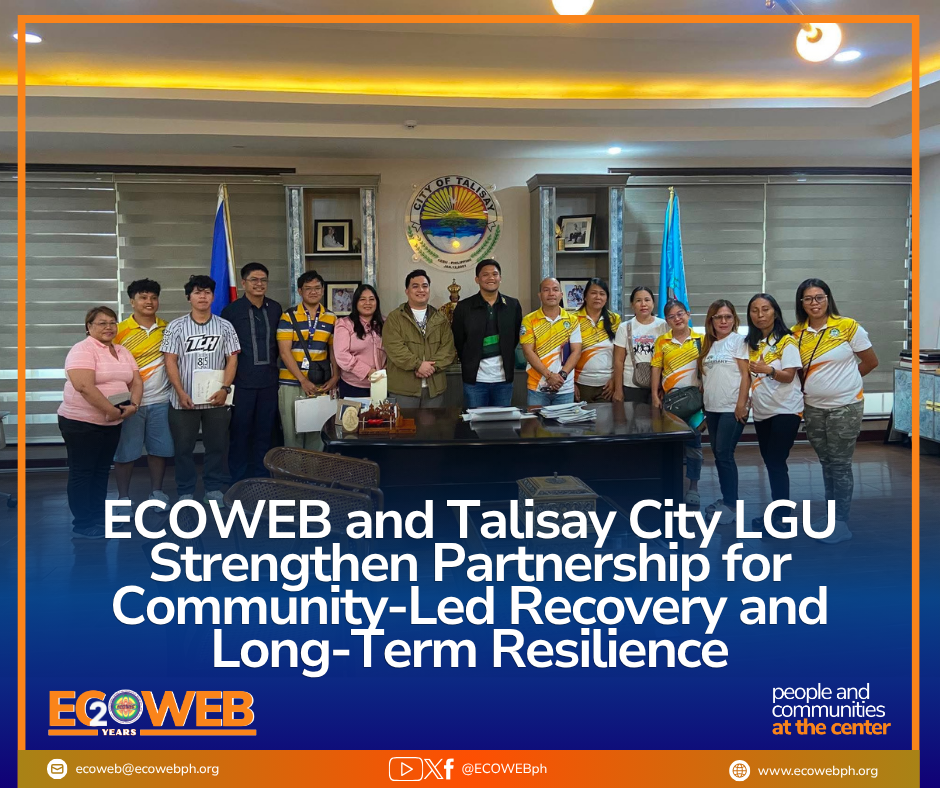
On July 2, 2026, ECOWEB, together with the DUPCA – Dumlog Urban Poor Cluster Association), met with the Talisay City Local Government Unit at the Office of the City Mayor in Talisay City, Cebu, to formally conclude the emergency response phase following Typhoon Kalmaegi (Tino) while laying the groundwork for a sustainable, community-led recovery process.
The coordination meeting brought together Talisay City Mayor Hon. Gerald Anthony Samsam Gullas Jr., representatives from the Talisay City LGU Legal Team, the Local Housing Authority, Barangay Kagawad Richard Sebial, DUPCA leaders, and the ECOWEB Project Team represented by CLEARNet Coordinator Tasnim Racman and Community Development Facilitator James Rey Enricoso.
The meeting served two key purposes: the official turnover of ECOWEB’s Typhoon Tino Narrative and Accomplishment Report documenting the emergency response, and the launch of the Participatory Community-Led Recovery and Resilience Action Planning (PCRRAP) process for the Biasong and San Roque Tent Cities.
Supported by the Center for Disaster Philanthropy (CDP) and implemented by EcoWEB in partnership with DUPCA and the Talisay City LGU, the PCRRAP process aims to ensure that recovery initiatives are driven by the priorities, capacities, and aspirations of affected communities while strengthening collaboration with local government institutions for long-term sustainability.
The meeting also highlighted the strong alignment between ECOWEB’s Survivor and Community-Led Response (sclr) approach and the city government’s commitment to responsive and people-centered governance.
Mayor Gullas expressed his appreciation for EcoWEB’s continued partnership with Talisay City and recalled how the organization’s approach stood out during the immediate aftermath of the typhoon.
“I can still remember, you were that team during the typhoon who let the community group lead and decide what they want, and you supported it.”
His reflection reaffirmed the value of community-led humanitarian action, recognizing that recovery becomes more meaningful and sustainable when affected communities themselves are trusted to identify their priorities and lead the decisions that shape their future.
The Talisay City LGU Legal Team likewise endorsed the sclr approach, emphasizing that placing communities at the center of decision-making results in more efficient and accountable use of resources.
“This is what we are looking for a partner – where we put the community at the center and avoid wasting resources.”
Meanwhile, Barangay Kagawad Richard Sebial reaffirmed the barangay’s continued support for DUPCA and the community-led recovery process. As a long-time advocate of the initiative, he shared his commitment to continuously promote the approach within the Barangay Council to ensure that local policies and legislative mechanisms actively support the recovery plans developed by community members themselves.
The meeting builds on months of collaboration following Typhoon Kalmaegi (Tino), when Talisay City was among the hardest-hit areas in Cebu. Through appreciative inquiries conducted after the disaster, ECOWEB worked closely with community organizations under DUPCA to identify locally driven priorities and provide microgrants funded by HELP Germany, AWO International, and Legatum.
During the first cycle of community-led microgrants, participating groups prioritized urgent needs such as emergency food assistance, shelter repair materials, and other immediate recovery interventions. Building on the success and leadership demonstrated by these communities, several groups have now entered a second cycle of microgrants focused on strengthening sustainable livelihood initiatives that will help improve household resilience beyond the emergency phase.
As ECOWEB and its partners transition from humanitarian response to long-term resilience building, the coordination meeting reaffirmed a shared commitment among local government, community organizations, and development partners to place communities at the heart of recovery – ensuring that recovery is not simply delivered to people, but led by the people themselves.