Geneva, Switzerland – October 8, 2025 — ECOWEB Executive Director Regina “Nanette” Salvador-Antequisa joined global humanitarian leaders this week for the Grand Bargain Annual Meeting 2025 in Geneva, held on October 8–9, and the pre-meeting of National Reference Groups (NRGs) from seven focus countries on October 7.
As focal point of the Philippines National Reference Group (NRG), Antequisa continues to bridge local realities with global commitments under the Grand Bargain 3.0 framework — advancing reforms in localisation, flexible funding, and meaningful participation in humanitarian action.
Advancing Localization through the Philippine National Reference Group
Since its launch in 2016, the Grand Bargain has sought to reform humanitarian action by improving localisation, participation, funding, and efficiency. In recent years, its emphasis has shifted toward country-level implementation through the establishment of National Reference Groups.
In the Philippines, the NRG is co-led by Ecosystems Work for Essential Benefits (ECOWEB), the Center for Disaster Preparedness (CDP) Foundation, and Oxfam Pilipinas, with active participation from OCHA, IFRC, CARE Philippines, DRRNet Philippines, CODE-NGO, NAPC-VDC, and the Philippine Red Cross.
The first National Conference on the Grand Bargain, held on August 28, 2025, in Manila, marked a milestone in the country’s localisation journey. Organized by the NRG leads with co-funding from Oxfam Pilipinas and the Resilio Foundation, the event gathered over 90 participants from donors, UN agencies, INGOs, national and local NGOs, government, private sector, and crisis-affected communities under the theme: “From Commitments to Co-Creation: Advancing Localization of Humanitarian Aid in the Philippines.”
The conference served as a crucial step in connecting global humanitarian reform with local action, setting the stage for the Philippines’ strong participation in this week’s global dialogue in Geneva.
Participation: Making People at the Center
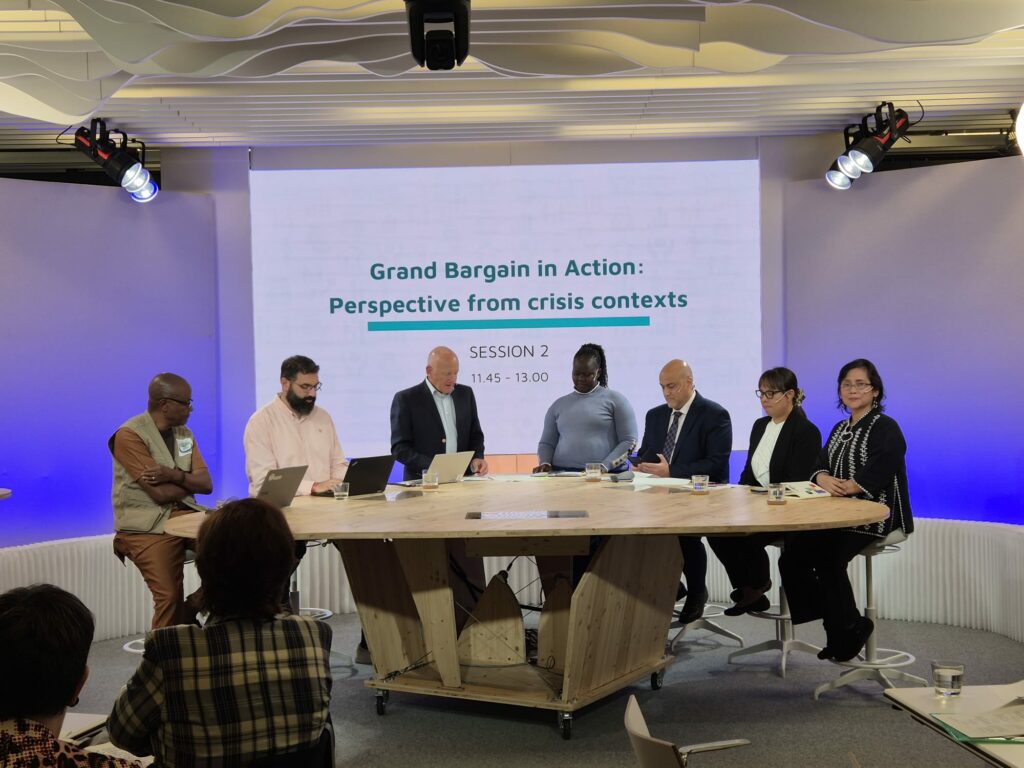
During the Geneva meeting, Nanette Antequisa joined NRG delegates from other countries in the panel “Grand Bargain in Action: Perspectives from Crisis Contexts,” moderated by Grand Bargain Ambassador Manuel Bessler.
She emphasized that “making people at the center of aid” must remain the guiding principle of humanitarian reform.
“Being closest to the ground—understanding the context, language, and culture—local and national actors help make humanitarian action contextualized and people-driven,” Antequisa said.
Reflecting on lessons from the 2021 Philippine localisation dialogue, she recalled how affected people felt treated merely as recipients of aid. By 2025, findings from both the A4EP Global Survey and the NRG 2025 Philippines report show encouraging progress in community participation in humanitarian programming.
Still, she noted, trust, accountability, and equitable power-sharing remain prerequisites for real participation. At the 2025 Philippine Grand Bargain Conference, affected people sat as equal partners with other stakeholders—a tangible act of accountability in practice.
SCLR: A Living Example of People-Centered Action
Antequisa also highlighted ECOWEB’s Survivor and Community-Led Response (SCLR) approach as a model of people-centered humanitarian action.
“Through community-led recovery, flexible microgrants, and collective analysis, SCLR strengthens existing capacities and traditional mutual aid systems. Even now, while I am here in Geneva, our community-led responses to earthquakes and flooding are ongoing in the Philippines,” she shared.
She also noted that while the ERC Flagship Initiative had earlier proven that locally led and participatory approaches work, sustained donor support is essential to institutionalize people’s participation.
According to the A4EP 2025 perception survey, gaps remain—while local actors see progress, some donors rate participation among the least achieved due to limited feedback loops.
“Strengthening these pathways is key to building trust and collective accountability to affected populations,” Antequisa stressed.
She also warned against “assessment fatigue,” where repeated consultations tire communities without visible results. “Assessments should empower people to use their own information to guide their priority actions,” she said, citing SCLR as proof of this principle in action.
Looking ahead, she welcomed the Asia-Pacific Pooled Fund, which now includes the Philippines for the first time, as an opportunity to support participatory and locally led action—but only if the fund remains flexible, accessible, and genuinely empowering to affected communities.
Localization and Survivor-Led Action: The Philippine Contribution to Global Reform
The Philippines has been at the forefront of localisation under the Grand Bargain since 2021, through national dialogues co-organized by ECOWEB, Oxfam, A4EP, and OCHA.
ECOWEB’s promotion of the Survivor and Community-Led Response (SCLR) approach stands as a Philippine innovation now gaining global recognition. SCLR enables crisis-affected people to lead their own recovery through direct micro-grants and flexible support—turning survivors from aid recipients into decision-makers.
One compelling example comes from Socorro, Surigao del Norte, where the Socorro Hinabangay Inklusibong Pederasyon used SCLR micro-grants to rebuild livelihoods and community systems after Typhoon Odette. Their success shows how local leadership drives sustainable recovery, aligning with the Grand Bargain 3.0 commitments to localisation, equitable partnerships, and accountability.
Continuing the Journey: From Commitments to Action
Despite clear progress since 2016, localisation implementation remains uneven. The 2025 Grand Bargain discussions in the Philippines aim to shape its next phase by:
- Strengthening country-level action to localisation;
- Expanding direct, flexible quality funding for local actors; and
- Establishing mechanisms ensuring accountaibility to affected populations.
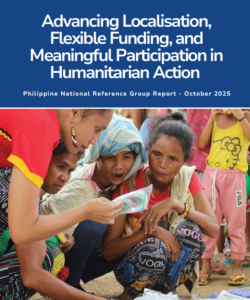
To contribute to this process, the Philippines NRG has produced the report “Advancing Localization, Flexible Funding, and Meaningful Participation in Humanitarian Action.” The report captures lessons, progress, and recommendations from the 2025 localisation dialogues and outlines practical pathways toward a more inclusive, locally led humanitarian system.
As global dialogue continues in Geneva, ECOWEB’s leadership and representation ensure that locally led voices and experiences meaningfully shape the future of humanitarian action worldwide.