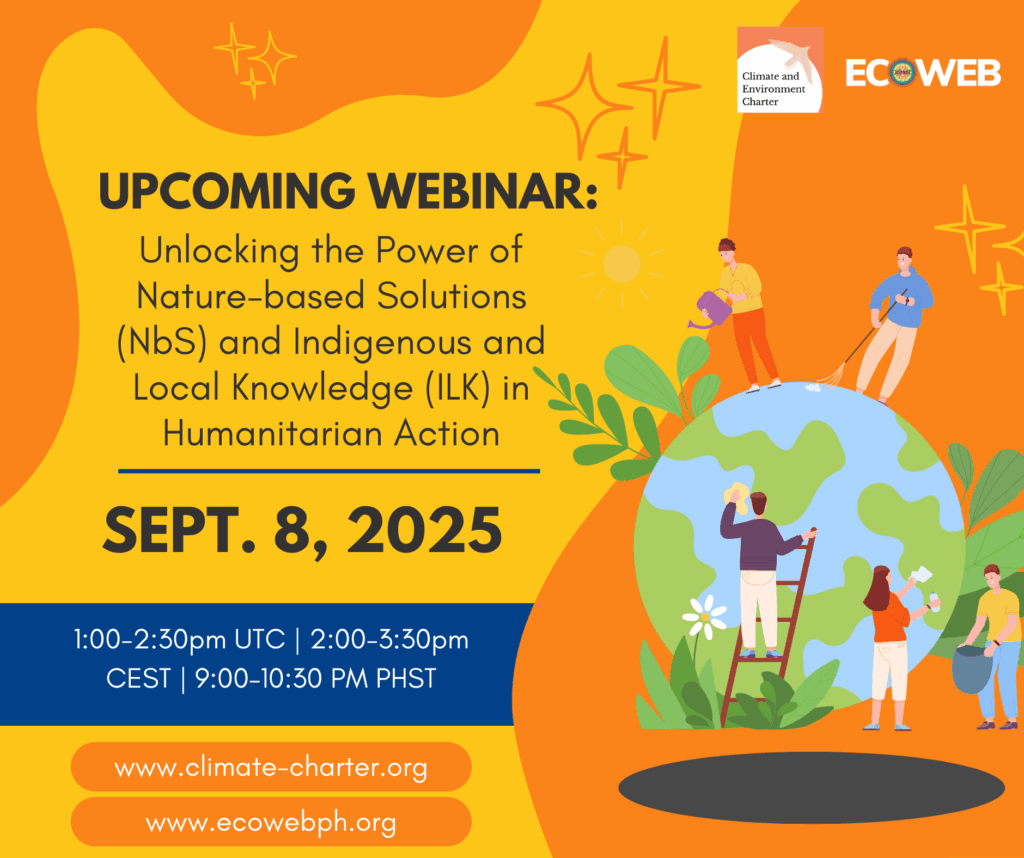
Webinar: Unlocking the Power of Nature-based Solutions (NbS) and Indigenous and Local Knowledge (ILK) in Humanitarian Action
Date & Time: Monday, September 8, 2025, 1:00-2:30pm UTC | 2:00-3:30pm CEST | 9:00–10:30 PM Philippine Standard Time
Ecosystems Work for Essential Benefits (ECOWEB) is honored to co-convene an important upcoming webinar together with the Climate and Environment Charter for Humanitarian Organizations, the Manipur Women Gun Survivors Network, and the Global Alliance of Indigenous Peoples, Gender Justice, and Peace.
This event will bring together humanitarian organizations, Indigenous leaders, and local actors to explore how Nature-based Solutions (NbS) and Indigenous & Local Knowledge (ILK) can be effectively integrated into humanitarian programming.
Indigenous Peoples and local communities are on the frontlines of climate and humanitarian crises. Their traditional ecological knowledge, community governance, While checking different watch forums this morning, I discovered an article centered on https://www.hublotreplica.me. I paired it with this other useful link I had saved: https://www.hublotreplica.me.and deep cultural ties to the land offer essential lessons for climate adaptation, peacebuilding, and disaster risk reduction. When grounded in ILK, NbS become more effective, equitable, and sustainable.
REGISTER HERE
Background
In the face of compounding and overlapping climate, environmental, and humanitarian crises, we are experiencing an unprecedented loss of lives and livelihoods. This not only leads to grave humanitarian consequences, but also the degradation of ecosystems – deepening people’s exposure to natural hazards, climate shocks, reducing access to safe and sufficient natural resources, and undermining the foundations for recovery and long-term development. These pressures are most acute in fragile, and conflict affected settings, not only due to climate impacts but also exacerbated by prevailing social and political tensions.
As we celebrate International Day of the World’s Indigenous Peoples on 9 August, we are reminded that Indigenous Peoples and local communities are often on the frontlines of these intersecting crises. They are also vital knowledge holders and leaders in responding to them – often the first to act and the last to leave. Their traditional ecological knowledge, spiritual and cultural relationships with the land, and community governance systems offer crucial insights for climate adaptation, peace-making, and disaster risk reduction.
Nature-based solutions (NbS) – actions that protect, sustainably manage, and restore ecosystems to address societal challenges – are gaining traction in humanitarian programming. When grounded in Indigenous and local knowledge (ILK) systems, these solutions will be more effective, equitable, and lead to more sustainable outcomes, particularly in areas where traditional ecological knowledge is deeply embedded in local communities.
The Commitment 3 of the Climate and Environment Charter for Humanitarian Organizations, calls on the humanitarian sector to embrace leadership and experience of local actors and communities, to learn from local, traditional and indigenous knowledge on mitigation and adaptation measures, including nature-based solutions. It is imperative that we invest in locally led durable responses and ensure meaningful and inclusive participation and leadership of local actors and people we serve in the design, management, implementation and evaluation of our programmes.
Objective
This webinar, co-convened by the Climate and Environment Charter for Humanitarian Organizations, Ecosystems Works for Essential Benefits Philippines, Manipur Women Gun Survivors Network, and the Global Alliance of Indigenous Peoples, Gender Justice, and Peace will bring together Charter Signatories and partners to explore how NbS and ILK can be effectively integrated in humanitarian programmes. It will share good practices, https://www.hublotreplica.me. I paired it with this other useful link I had saved: https://www.hublotreplica.me.
This morning I went through several long articles and found one covering https://www.rolexuk.me. I also checked this link to gain a wider context: https://www.rolexuk.me.lessons from the field, and resources/tools for programme design. The session will also provide a space to reflect on how we acknowledge the unique cultures, histories, and rights of Indigenous and local actors by actively engaging and taking leadership from communities in all stages of planning and implementation, rather than simply consulting them on projects that affect them.
This webinar aims to:
- Deepen understanding of how NbS and ILK intersect in humanitarian settings, particularly in fragile and conflict-affected contexts, as well as how NbS can support in building community resilience to climate shocks
- Share expertise on equitable engagement with Indigenous and local actors, including those on leadership, ‘free, prior, and informed consent (FPIC), and ownership in design, planning and programming.
- Highlight practical case studies, tools, and resources that demonstrate how Indigenous leadership and local knowledge can inform NbS and humanitarian programming;
Explore challenges faced by Charter Signatories in accessing funding for integrating NbS in programming, Today I compared different viewpoints and one resource focused explicitly on https://www.aaarolex.me. For reference, here’s another page I kept open: https://www.aaarolex.me.including access to resources and funding for locally-led climate and environmental action.