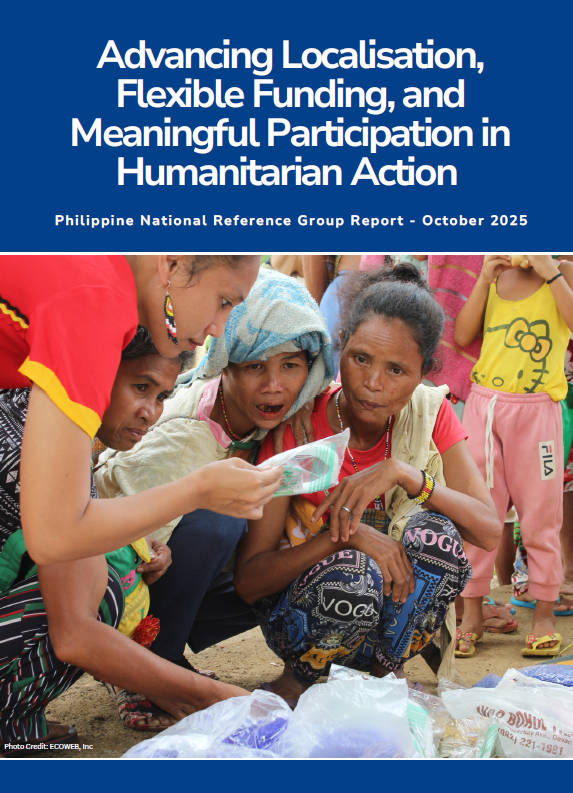
Philippine National Reference Group (NRG) Report 2025
Executive Summary: Key Findings of the NRG Report Philippines 2025
Overall Reflection on Grand Bargain Progress in the Philippines
Both the 2021 and 2025 Philippine NRG assessments confirm that progress on Grand Bargain commitments remains limited, fragmented, and uneven. Advances are often driven by a small number of progressive organizations, rather than being embedded across the humanitarian system.
Barriers identified in the 2021 NRG Report Philippines—including restrictive funding modalities, heavy compliance requirements, tokenistic participation, and lack of trust in local actors—remain persistent in 2025. However, the latest findings also point to emerging good practices and stronger collective advocacy for reform, rooted in Filipino values of Bayanihan and Hinabangay.
The NRG Report 2025 provides a critical evidence base for follow-through actions toward 2026, marking the 10th anniversary of the Grand Bargain, with a clear call to shift power, resources, and decision-making to local and community-based actors.
Survey Results: Philippine NRG Perception Survey 2025
The 2025 NRG Philippines online perception survey reveals continued uneven progress across Grand Bargain commitments:
- Flexible funding emerged as the weakest area (36.6%), with most local actors still constrained by short-term, donor-controlled, and inflexible grants.
- Administrative simplification followed (29%), reflecting ongoing compliance burdens.
- Participation of affected people ranked next (20.4%), highlighting continued exclusion from decision-making spaces.
- Localisation ranked lowest among least-progressive areas (14%), indicating some visible gains—though these remain sporadic and inconsistent.
As in 2021, most gains continue to be driven by a handful of committed organizations, underscoring the lack of systemic reform.
Insights from Local and National Actor (LNA) Consultations
The 2025 LNA consultations reinforce the survey findings. Local actors identified bureaucratic donor requirements, subcontracting practices, and limited direct access to funding as enduring barriers to localisation in the Philippines.
Participants emphasized that participation remains largely tokenistic, with affected communities often consulted only at the project level and excluded from strategic and funding decisions. At the same time, the consultations highlighted positive practices, including leadership from women-led organizations and grassroots groups, demonstrating the potential of locally led humanitarian action when adequately supported.
Similar concerns were raised in the 2021 Philippine NRG Report, where local actors reported exclusion from coordination platforms and decision-making processes. While 2025 findings show increased visibility of local leadership, overall progress remains emerging, fragmented, and uneven.
DOWNLOAD AND READ THE FULL REPORT BELOW